
Thank you to Alison Hayes, Newmarket Journal for allowing us to reproduce this article.
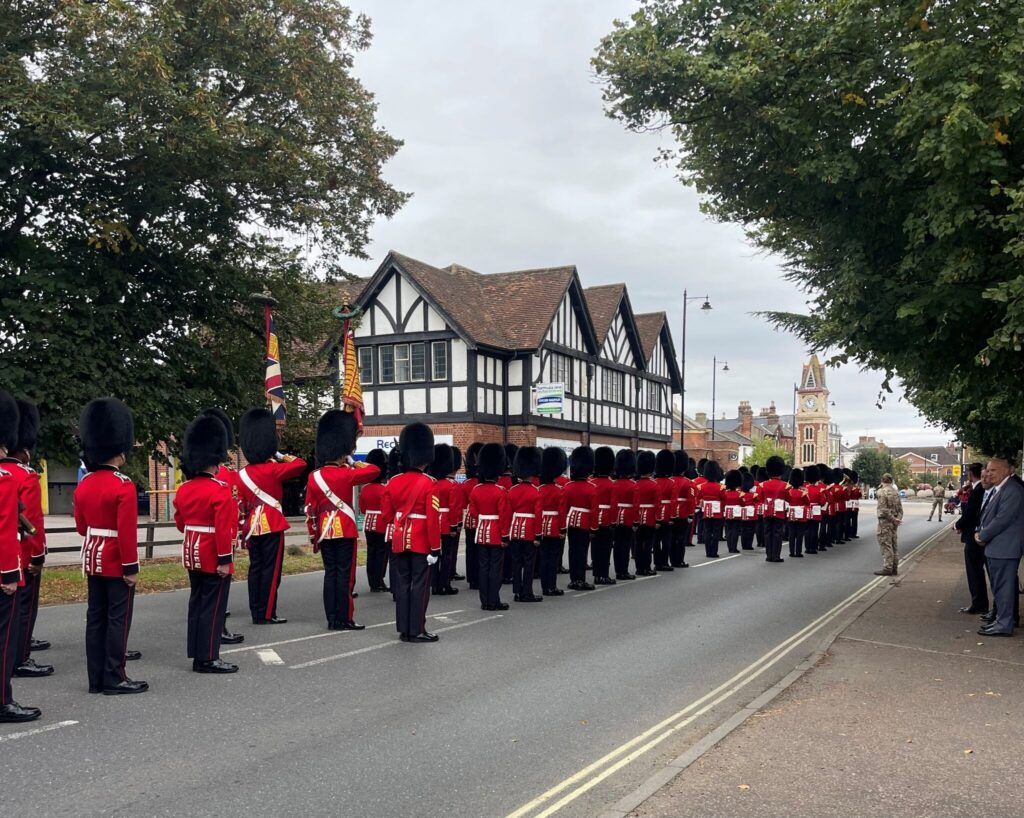
Large crowds greeted the Grenadier Guards as they retraced the steps of their historic regiment marching, with drums beating and colours flying, through Newmarket ahead of it becoming the first town amongst an elite group of cities to have bestowed them with its Freedom.
The High Street parade and presentation at Tattersalls, ahead of a free concert, on Saturday September 12 recognised the close historical association between Newmarket, King Charles II and his regiment, the First Guards, forerunners of the Grenadiers, the British Army’s most senior infantry regiment which this year had been marking its 370th anniversary.
The unit traces its origins back to loyal troops raised in Bruges in Belgium in 1656 as the King’s Own Regiment of Guards during Charles’s nine-year exile following his disastrous defeat at the Battle of Worcester, the last major conflict of the English Civil War, at the hands of Oliver Cromwell’s forces.
Amongst the first officers of the First Guards were some of the monarch’s fellow fugitives from the battle who had helped him escape with his life at great risk to their own. It was from these loyal compatriots that the King created his most trusted personal troops, the predecessors of the Grenadier Guards.
One of them, William Carless, had helped the King hid in the branches of an oak tree at Boscobel in Shropshire as troopers from Cromwell’s New Model Army searched for him. His loyalty was was rewarded with a commission in The First Guards.
And as a permanent reminder of the dramatic royal escape the King conceived the design for the 20th Royal Badge presented in 1660 which featured his head in an oak tree.
In 1665 these loyal troops combined with another royal regiment to officially form the 1st Regiment of Foot Guards. The following year Charles II, six years after his Restoration, returned to Newmarket as King for the first time and would then visit two or three times a year taking his court with him and establishing the town as the unofficial second capital of England.
“In the early years of the King’s visits, a sense of anticipation amongst the people of the town would grow with the arrival of a company of The First Guards, the King’s own regiment, which would have marched from London and be ready for the King’s arrival,” said former Grenadier Guards officer Paul Cordle. “Excitement grew further with the arrival of the King himself and his mounted Sovereign’s escort, now The Life Guards which he had formed in 1658. Over the 18 years of his regular visits, officers and men of the two regiments would have become familiar with Newmarket and its people.”
While Charles stayed in the new palace built in the town replacing the dilapidated royal residence built for his predecessor James I, men of The First Guards were billeted in the town’s many taverns. The King was in the process of buying one of them, The Sword in Hand, believed to have been in the High Street, which he planned to refurbish as a guard house but fate got in the way.
Seventeen years after the Great Fire of London in 1666 Newmarket was also ravaged by a huge blaze which had begun at one of the town’s stables and fanned by the wind, destroyed half of the town, including The Sword in Hand. The King however remained true to his word and completed the purchase of the property.
Because of the disruption to sport caused by the fire, the King left Newmarket earlier than intended thereby unwittingly foiling an assassination plot. A group led by the Earl of Essex had intended to kill him as he passed the Rye House near Ware in Hertfordshire on the day he had originally planned to travel back to London but, as the plotters had no knowledge of the King’s change of plan, the so-called Rye House Plot failed.
The King paid his last visit to Newmarket in 1684. He died on February 6 the following year having consolidated the town’s reputation as the country’s most famous centre of sport and, through his participation and patronage, laid the foundations of its enduring fame as a centre for horse racing.
Since their formation the guardsmen have fought in every major conflict in British military history from the 17th century Battle of Tangier, through both World Wars, to recent operations in Afghanistan. It was in 1815, after the regiment famously defeated the Grenadiers of the French Imperial Guard at Waterloo, that it adopted that unit’s famous bearskin headdress and a flaming grenade as its cap badge. The victory also prompted its grenadier title but it wasn’t until 1877 that its name officially changed to the Grenadier Guards.
Today, the regiment is formed of fighting soldiers who carry out a specialist light infantry role during operations and, when in the UK, take part in high-profile ceremonial duties.
In June of this year King Charles III paid tribute to the courage, resilience and enduring spirit of the Grenadier Guards as he presented new colours to the regiment’s 1st Battalion.
Newmarket’s mayor Cllr Philippa Winter who formally presented the Grenadiers with the Freedom of Newmarket scroll, said it had been a great occasion with residents turning out in force to greet the regiment and celebrating its long and illustrious history which is so inextricably linked with that of their town.